 PodcastCodex
Podcast Transcripts That Follow Your Ears
A good podcast transcript is timestamped, searchable, and synced to playback: it highlights as you listen and taps straight into any line.
 ForgeAppsSeptember 18, 20267 min read
A podcast transcript is only as useful as its sense of where you are. For narrative shows (audio dramas, serialized fiction, deep-dive history), the transcript that actually helps is timestamped to the audio, highlights as you listen, lets you search a half-remembered line, and jumps the playhead when you tap. A static wall of text in the show notes does none of that, which is why most podcast transcripts go unread. This is about the version that earns a place next to the play button.
Why do narrative podcasts need transcripts most?
An interview show can survive without text; a narrative show cannot, for one specific reason: it traffics in names you have never seen spelled. Invented kingdoms, honorifics, family names your ears guess a spelling for and your memory files under the guess. A synced transcript fixes that mishearing the moment it happens. The other wins are just as concrete: you can quote a line exactly instead of paraphrasing it badly in a recommendation, search for the half-remembered sentence about the harbor, keep up through traffic noise or a dead headphone, and, not a small thing, the show becomes reachable for d/Deaf and hard-of-hearing listeners and for anyone who simply retains more with their eyes open.
Full-cast audio dramas make the case even harder. A narrator who names everyone is one thing; a tavern scene where four voices trade rapid lines and nobody says a name for three minutes is where listeners actually lose the thread. That is the moment a transcript stops being an accessibility feature and becomes the difference between following a scene and surrendering to it. Narrative history has its own version: dates, treaties, and reigning names arrive in clusters, and text gives you a place to check which Henry is dying this time.
What is wrong with a transcript in the show notes?
Some publishers attach a transcript as a PDF or a page on their site, and it is better than nothing, but it is position-blind. Finding where you are inside nine thousand words means scrolling and squinting while the episode keeps playing or you lose the thread entirely. It lives outside the player, so every lookup costs you your place. And it does nothing for the other transcript jobs: you cannot tap it to re-hear a line, and searching it gives you a paragraph in a document, not a moment in the audio.
Static text versus a synced transcript
| What you need | Transcript in show notes | Synced transcript in the player |
|---|---|---|
| Know where you are | Scroll and guess | Highlight follows playback |
| Find a half-remembered line | Search a whole document | Search jumps to the moment |
| Hear a line again | Hunt for the timestamp | Tap the line to scrub there |
| Check how a name is spelled | Hope the spelling is right | Read it as it is said |
| Stay spoiler-safe | The whole episode's text | You only see where you are |
What does 'synced' actually mean?
Three mechanics, each boring on its own and transformative together. First, the highlight follows playback: the line currently being spoken is marked, so the transcript always opens at where your ears are. Second, every line is a scrub point: tap it and the audio jumps to that timestamp, which turns 'rewind and hope' into 'tap the sentence'. Third, search resolves to moments, not paragraphs. Looking up a phrase lands you on the exact line and lets you press play from it. Together they stop the transcript from being a document and make it a control surface for the episode.
Three moves worth learning
- 1
The misheard name
Search your best guess at the name. Even a wrong spelling usually lands near the right line, and the transcript shows you the real one in context.
- 2
The missed stretch
Noise swallowed a minute of dialogue? Scroll the highlighted region back to where you lost the thread and read the gap instead of re-hearing it.
- 3
The half-remembered line
Search a distinctive phrase from earlier in the episode, tap the result, and the audio jumps straight to the moment it was said.
How do you use one without reading the whole show?
Treat it like a dashboard, not a book. The trap with any transcript is that it quietly turns listening into reading, and then the audio becomes the accompaniment. The better habit is a glance discipline: the transcript is where you check a spelling, re-read the line that hit you, or bridge a gap. Then your eyes go back to whatever you were doing. Listeners who use transcripts well tend to touch them three or four times an episode, not follow them line by line. The highlight following your position is what makes the glances cheap: there is no scrolling to find yourself.
There is a quieter benefit too: transcripts change how you talk about shows. Recommending an audio drama is hard when you cannot spell the protagonist's name or quote the line that sold you. Being able to pull the exact sentence, and know the episode and moment it came from, is the difference between 'it's good, trust me' and a pitch that actually lands.
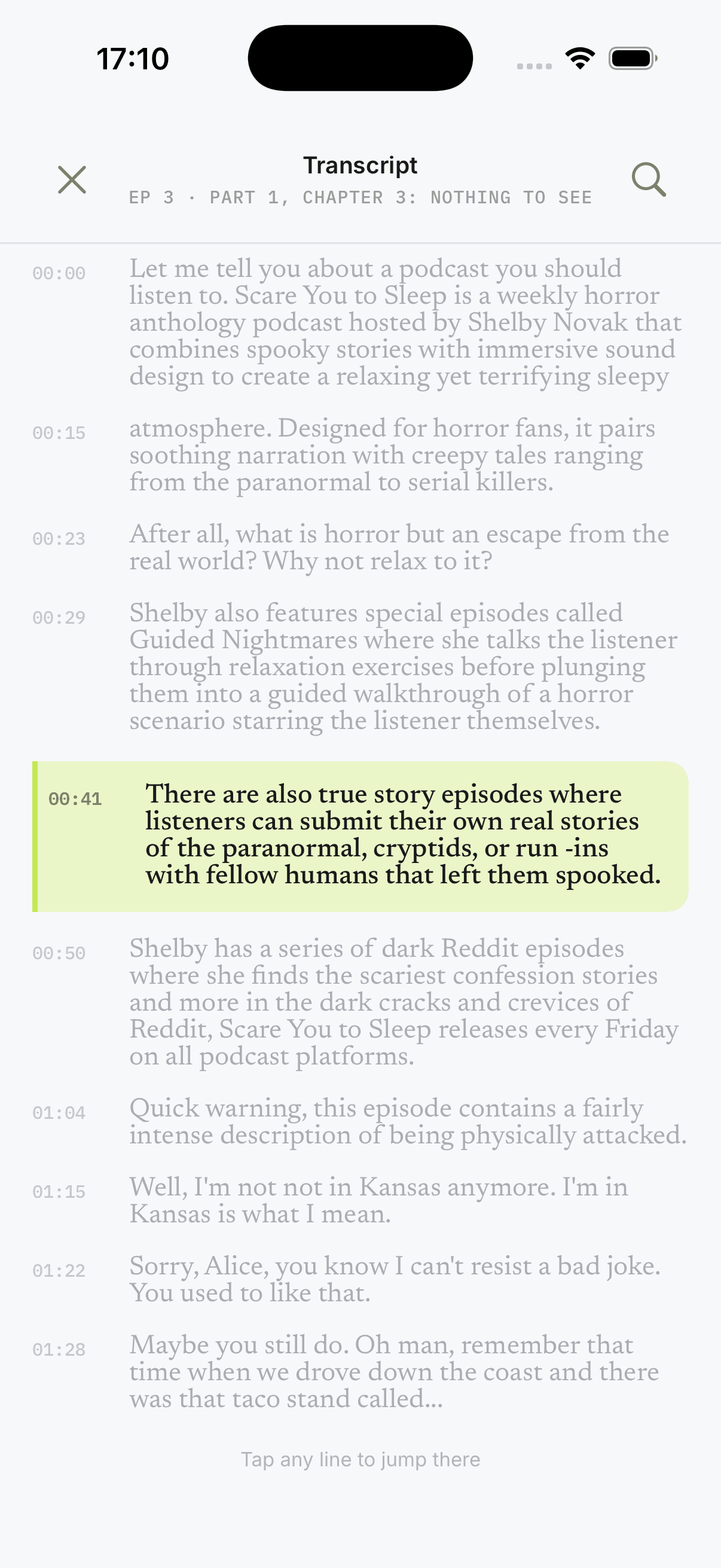
In PodcastCodex the transcript sits inside the episode: timestamped, highlighting during playback, searchable, and scrubbable. It also pairs naturally with the codex. The transcript gives you the exact wording of a scene; the codex tells you who is in it, spoiler-safe to your position. A name that slid past your ears gets resolved twice (spelled correctly on the page, explained in the entry), which is most of the battle described in how to remember podcast characters.
Where transcripts still fall short
The honest limits: transcripts exist for shows with codex coverage, not for every feed in your library. Everything else still plays fine as a normal podcast. Invented names can lag, too: analysis hears 'Vaelis' and sometimes guesses a spelling before the show confirms one, so an early transcript can misspell a fantasy name it has no dictionary for. And a transcript fixes wording, not attention. If you zoned out for ten minutes, the tool you want is a recap, and the PodcastCodex overview covers how Previously On handles that.
A synced transcript earns its keep when you
- Misheard a name and want the real spelling, not your guess
- Need to quote the show exactly for a review, a post, a recommendation
- Half-remember a line and want the episode and moment it lived in
- Lost a stretch to traffic noise, a tunnel, or a dying earbud
- Are hard of hearing, or simply retain more reading along
- Want to re-hear one line without scrubbing blind
Transcript questions, answered
Which podcasts have transcripts?
Some publishers ship their own transcripts, but coverage is patchy. In PodcastCodex, timestamped transcripts are produced for shows with codex coverage; other shows still play normally without one.
Can you search inside a podcast transcript?
With a synced transcript, yes, and the result jumps to the moment in the audio, so you can press play from the line you found rather than a paragraph in a document.
Are podcast transcripts accurate?
Mostly, with one honest caveat for fiction: invented names can be misspelled until the show's spelling is confirmed. Dialogue, places, and ordinary wording hold up well.
Is reading along while listening actually helpful?
For cast-heavy fiction and dense history, yes. It gives memory a second anchor, fixes name spellings your ears guessed at, and keeps a noisy environment from costing you a scene.
Next time a name slides past mid-scene, do not rewind. Open the transcript, search your best guess at it, and tap the matching line: you get the real spelling and the exact timestamp in one move.
PodcastCodex is free to try on the App Store. The transcript will be waiting for the next name your ears cannot spell.
Keep the story clear
Try PodcastCodex for free.
Listen to any serialized show with a spoiler-safe story codex that stays exactly at your position.
 Download on theApp Store
 Coming soon toGoogle Play