 PodcastCodex
The Podcast Codex, Explained
The podcast codex is a spoiler-safe encyclopedia inside the player: entries for characters, places, and terms unlock only once your playhead reaches them.
 ForgeAppsAugust 7, 20267 min read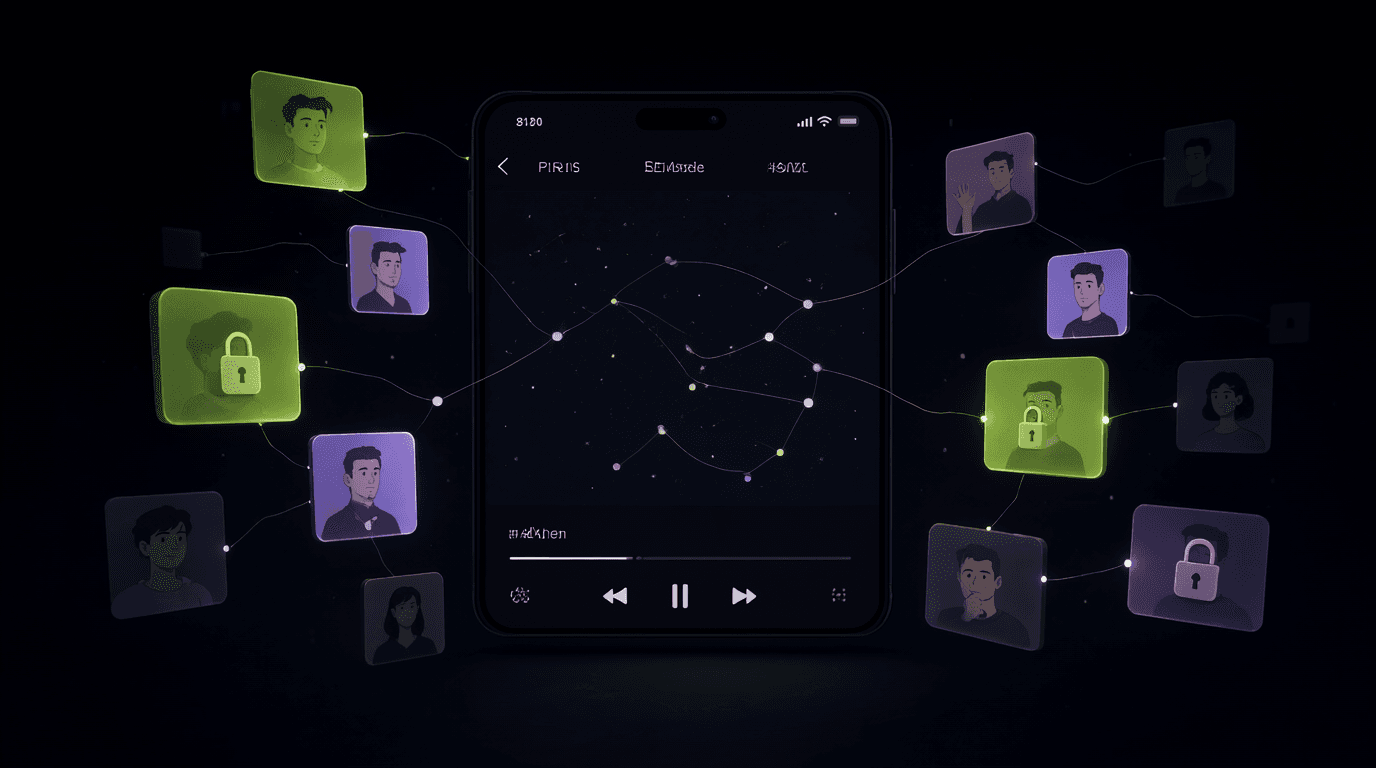
A podcast codex is a built-in encyclopedia for the show you are listening to, but unlike a fan wiki, it only knows what you have already heard. If you have ever paused an audio drama to wonder 'wait, who is she again?' and then refused to google it because the first result would tell you she dies in season three, the codex exists for exactly that pause. In PodcastCodex it holds entries for the characters, places, and terms of a supported show, each one unlocked and bounded by your exact playback position.
Fan wikis are written backwards from the ending. The people editing a character page know how the story finishes, and that knowledge leaks into the very first sentence: 'later revealed to be', 'before his betrayal', 'shortly before her death'. A codex runs the other direction. Every entry is anchored to the story moment where it first matters, and its text only ever covers what the show has narrated before your playhead. You get the answer a wiki would give (who this person is, where you heard the name) without the spoilers a wiki is guaranteed to smuggle in. The reasoning behind that design is covered in why podcasts need spoiler-safe wikis.
Entries come in three kinds. Characters are the obvious one: the people whose names blur together by episode thirty. Places cover the geography a show expects you to hold in your head: the city, the pass, the border province mentioned once in season one and suddenly load-bearing in season four. Terms are everything else a story coins: factions, titles, rituals, invented vocabulary, the words your ears can hear a dozen times without ever really landing. A drama that name-drops its treaty, its church, and its dead queen in one scene is exactly what the codex is built for.
What does a codex entry contain?
Anatomy of an entry
Name and aliases
Every way the show refers to the same thing. A narrator's 'the Hollow King', another character's 'Prince Aldric', and a whispered 'the usurper' resolve to one entry, so you never hold three half-records for the same person.
Mentions
How the name has surfaced across episodes up to your position: the fastest way to tell whether a passing name is set dressing or a slow-burn lead.
First heard, last heard
When the entry first mattered and the most recent time it appeared before your playhead. 'Last heard' is usually the real answer to 'where do I know this from?'
A description capped at you
The entry summarizes only what the show has already narrated at your position. Same entry, different listener, different episode: a different truth, and a safe one.
How does the gating work while you listen?
Entries start sealed. When your playhead crosses the moment an entry first matters (a character's introduction, a term's first explanation, a place's first visit), it unlocks on its own. There is nothing to tap and nothing to earn; the codex simply grows to match what you have heard. Fall behind on a season and it stays small. Binge three episodes on a long drive and it grows with you. Entries ahead of your position stay locked, so browsing the codex itself can never betray you.
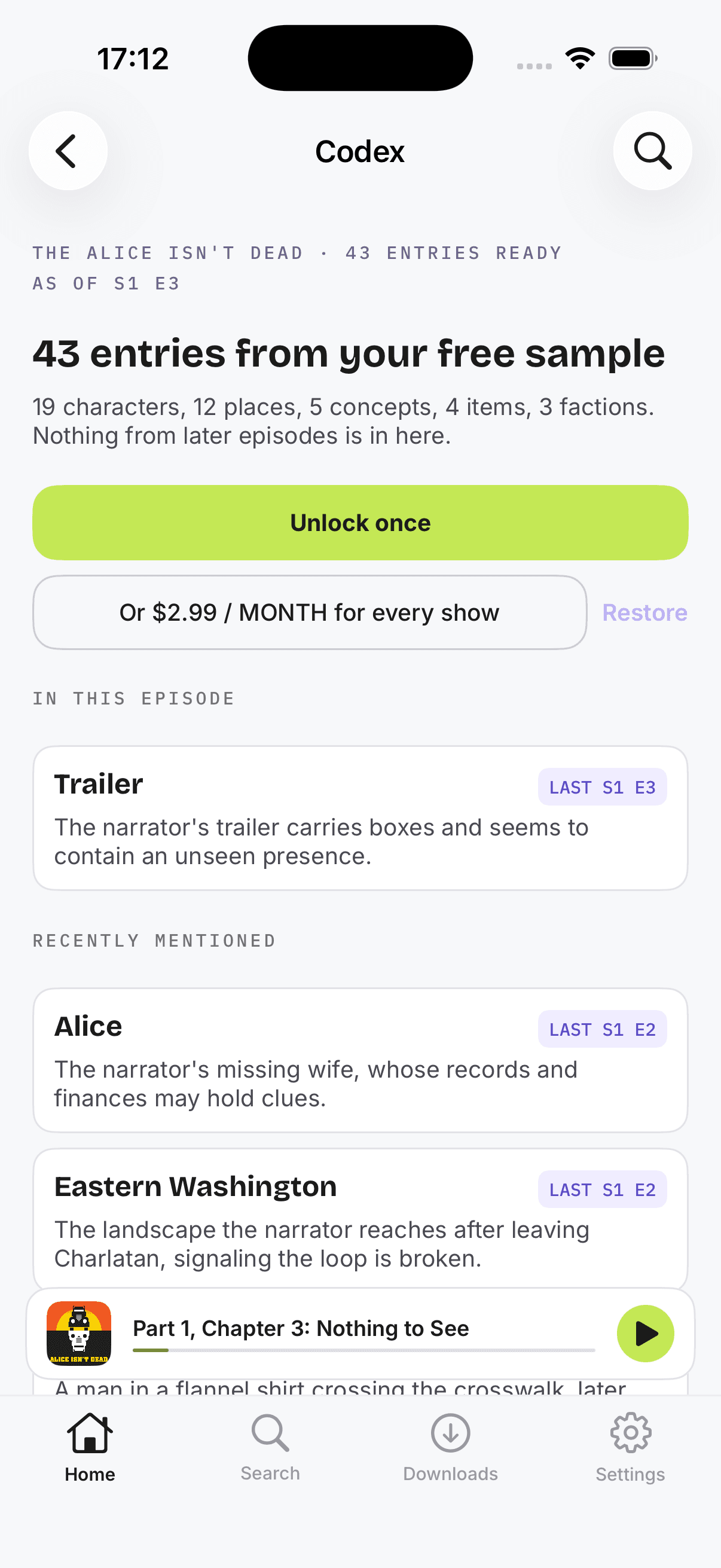
The most visible piece lives on the Now Playing screen: the In This Scene strip stays live to your playback position and surfaces the names relevant right now. When a scene stacks three speakers you only half-remember, the strip answers 'who is actually in this scene' without opening a single entry. For bigger lookups, or for getting back into a show you set down, the Previously On recap summarizes everything before your playhead, which is its own topic in catching up on a podcast after a break.
What happens as you listen
- 1
Press play like normal
Subscribe by RSS or directory search and listen the way you would in any player: stream or download, background playback, lock screen controls, resume where you left off.
- 2
Entries unlock at their moment
Cross the point where a character, place, or term first matters and its entry opens automatically. Everything ahead of you stays locked.
- 3
Look things up mid-scene
When a name nags at you, open the entry: aliases, mentions, first heard, last heard, and a description that stops at your position. Ten seconds, no spoilers.
- 4
Re-enter after a break
The Previously On recap rebuilds your context from before the playhead, so weeks away cost a minute of reading instead of hours of re-listening.
Codex vocabulary, in plain terms
- Position gating
- The rule under everything else: an entry only reveals what the show narrated before your current playback position, and stays sealed before that.
- Anchor moment
- The point in an episode where an entry first matters: the moment your playhead has to cross for the entry to unlock.
- Mentions
- The trail of where a name has surfaced across episodes up to your position, so you can gauge how much a character actually matters yet.
- First heard / last heard
- When an entry first appeared and when it most recently surfaced, usually the answer to 'where do I know this name from?'
- In This Scene
- The strip on the Now Playing screen that stays live to playback and shows the names relevant to the moment you are hearing.
- Previously On
- A recap that summarizes everything before your playhead, built for re-entering a show after a break without re-listening.
- Wish
- An in-app request for codex coverage of a show that does not have it yet. Wishes are what prioritize the analysis queue.
Where do codex entries come from?
Coverage is produced by server-side analysis of public podcast episodes, not by a wiki's worth of volunteer editors. That has two consequences worth knowing. First, it improves over time without any work on your phone. Analysis runs server-side and coverage deepens as it goes. Second, it means a codex exists per show, not per feed: shows without coverage still play perfectly, because PodcastCodex is a complete podcast player first.
Coverage is also demand-driven. If your favorite show has no codex yet, you can wish for it inside the app, and wishes are how coverage gets prioritized: the loudest audiences get their shows analyzed first. Two boundaries are absolute: private and paywalled feeds you add by URL stay on your device and are never sent for analysis, and no entry ever draws on episodes beyond your playhead.
What a codex is, and what it is not
It is not a wiki, not show notes, and not a chatbot you can interrogate. Ask it 'who is the traitor' and it cannot answer, because that answer lives ahead of your position. The same gate that protects you also limits it. Coverage is finite, and interview, news, and panel shows are out of scope by design: a codex only makes sense where there is a story to track. PodcastCodex is iOS only for now, on iPhone and iPad. The iPad layout gives the library a second column and the codex its own rail, which suits browsing a cast while a scene plays. For the full picture of the player the codex lives inside (subscriptions, downloads, pricing), start with What Is PodcastCodex?.
Quick answers about the codex
Is a podcast codex just a wiki inside an app?
No. A wiki is written to the end of the story by people who finished it. A codex entry is anchored to the moment it first matters and gated to your playback position, so it only ever describes what you have already heard.
Can a codex entry spoil anything?
No. Entry text covers only what the show narrated before your position, and entries you have not reached stay sealed, even while browsing the codex itself.
What if my show has no codex yet?
It plays like any episode in any good podcast player. You can wish for coverage inside the app. Wishes are what prioritize which shows get analyzed next.
Does using the codex cost extra?
The first five episodes of every supported show play free with the codex active. After that, a one-time per-show unlock never expires, or the optional monthly plan covers the whole catalog.
Open the codex at the end of an episode, not just when you are lost. The freshest entries are the ones that just unlocked, and a quick skim doubles as a sixty-second review of what you just heard.
PodcastCodex is free to try on the App Store. Pick a serialized show, listen to the opening arc, and watch the codex fill in behind you.
Keep the story clear
Try PodcastCodex for free.
Listen to any serialized show with a spoiler-safe story codex that stays exactly at your position.
 Download on theApp Store
 Coming soon toGoogle Play